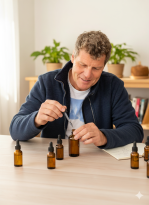
Content 50 ml
Recommended treatment
Free shipping on orders of more than € 30.00
VAT included

Living with anxiety is difficult. You may feel alone, because you struggle to explain to others what it is you’re going through, or you may find that others become impatient with you because they don’t understand the condition. Anxiety can be a chronic condition that lasts for years, or it can be acute and come and go. If you suffer with anxiety, it’s important that you learn to live with it, and adopt techniques that help you manage how you feel, when anxiety interrupts your day to day life. The alternative is that you passively accept your anxiety and do nothing about it, but this will increasingly make you feel unwell. Far better to tackle the problem head on.
Face up to the fact that you have anxiety and that you need to tackle it. You may not ever completely eliminate your symptoms of anxiety, but knowing you suffer with it, and letting others know that you suffer with it, are two very important steps. Remember, the more control you assert over your life, the less likely you will be to have symptoms.
Anxiety is often worsened by an inability to breathe properly. If you are having an anxiety attack – similar to a panic attack – take steps to calm your breathing down. The aim is to slow your breathing down and breathe deeply. If it helps, breathe deeply, deep into your diaphragm, watch your chest lift up and your stomach swell and hold that breath for 5 seconds, before slowly letting it go and watching your chest collapse. Put your shoulders back and repeat until you feel calmer.
Anxiety tends to attack when you overthink issues. Allowing yourself thinking time, or down time, is one sure fire way to let anxiety attack you. One way to tackle this is to keep busy from the moment you wake up until the moment you go to bed. Exhausting? Definitely. But with any luck you’ll sleep well too. It doesn’t have to be physical busyness. You could be reading or doing some craftwork, or maybe even meditating. Stay focused and engaged, so that your thoughts can’t turn inwards.
Hand in hand with being busy, is taking exercise. It’s not everyone’s cup of tea, but taking exercise several times a week is a great mood enhancer and can really help you to feel better about yourself. It doesn’t have to be hard core aerobic exercise either. You can indulge in some yoga, go for a walk or swim lengths at the swimming pool. Exercise raises your serotonin, burns away stress hormones and releases endorphins which improve your overall mood.
Another method for tackling your symptoms of anxiety is to focus on where you get them. For example, if your neck gets tense, bring your attention to your neck. If it’s a fluttery sensation in your abdomen, concentrate on that sensation. If you find it hard to breathe, concentrate entirely on your breathing. Worry that feeling, like a dog with a bone, and if your attention wanders away, bring it back. Keep doing this until you feel calmer.
Sometimes our anxiety is a sign that we are too self-involved. Another way to help eliminate some of your symptoms of anxiety is not to over-indulge ourselves but to think of others. Do you know anyone else in need? A family member, a neighbour or a friend? If not, can you find a way of volunteering some of your free time to a good cause? By doing so you will take your mind off your own problems, and find joy in helping others.
While we wouldn’t normally advocate avoidance behaviour, when you suffer with anxiety there are certain triggers that can set off an attack. If you know what these are, and you are not receiving therapy or treatment to help you deal with the triggers, there is no reason why you shouldn’t avoid them. If watching the news makes you anxious, turn the TV off or over. If seeing your ex on social media sets you off, delete your profile or block him or her. This is particularly important in the few hours before bedtime. Upsetting yourself in the evening will invariably mean hours spent tossing and turning before dawn.
If you are able, try to push your boundaries a little every day. You may find that you can counter some of your symptoms of anxiety by facing the thing you fear the most. This could mean talking to someone new every day, for example, or driving a mile down the road to somewhere new. It doesn’t matter what it is, and no-one else has to know. Set tiny goals for yourself and see how you get on.
When you know the things that tend to cause your symptoms of anxiety, consider what is the very worst thing that can happen. What is the foulest possible end result? Even at its most awful, you will still survive and you won’t have destroyed the world so there’s no point unduly worrying. If you start to panic, calm your breathing down. Eventually your panic will die away. You’re absolutely fine.
When the world is getting on top of you, make lists of all the things you adore. This could be rice pudding, Beatles albums, your dog, the rain on a tin roof, the sound of the sea on a pebble beach – it can be anything that makes you happy. Some people make lists and dedicate a notebook to their lists – often called a gratitude journal. Go shopping and buy yourself a beautiful notebook to keep your happy thoughts in.
This can sometimes be easier said than done, when you’re in the pit of despair but trying to see advantages instead of disadvantages, the good instead of the bad, and the possibilities instead of the blocks, will really help you to stay focused on enjoying life.
You cannot cure your anxiety overnight, and sometimes it cannot ever be cured, but you can work within your means to constantly improve matters for yourself. Keep talking to others about how you feel, treat yourself to things that you love, and have faith that life will improve.
Created by Tom Vermeersch

Tom Vermeersch is a certified Psychologist and Bach flower expert with more than 30 years of experience.

Do you sometimes despair about humanity because it seems there are far more bad people than good? Are we primarily selfish individuals, thinking only about our own needs? Or is this cynical belief just because we spend so much time online? The truth is more complicated!

Subtle signs your child is unhappy
According to figures from the World Health Organisation, more than 260 million people worldwide suffer from depression. And it's not only adults who are diagnosed with this illness. Children as young as three or four years old can experience depression.

Is the world as we know it over?
Since the outbreak of the COVID-19 pandemic, governments around the world have taken unprecedented measures to stop the spread of coronavirus. The rapid changes we've seen have had an impact on almost every aspect of our lives.

Six things we think will make us happy, but don't!
When you think about things that will make you happy, what are the images that come to mind? Wealth, beauty, a dream house, long holidays, a top of the range car? Happiness is not a constant and how happy we feel depends on the way we choose to live our lives.

Dealing with British Summer Time
Some people are overly sensitive to the time change and it can take days, if not weeks, for them to feel right again, while others barely even notice.

It’s such a positive thing to do and hope springs eternal, so why not commit yourself to a change this year? Here’s our tips on how to stick to your new year’s resolutions.

Isn't depression just a fancy word for feeling a bit down?
Mental health issues such as depression and anxiety affect around 1 in 6 people at some stage of their life. Despite it being such a common problem, many sufferers wait months or even years before seeking help.

What to do when the spark is fading
Why do you feel butterflies at the start of a new romance, and how can you keep the flame burning in a long term relationship as the spark starts to fade?

Nowadays, it can sometimes seem almost everyone has a mental health issue or learning disorder. But, are we too quick to label people, or is it that we are more aware of the problems? This article looks at some of the issues surrounding these sensitive questions.

How to stop everything going wrong
Do you always feel that everything’s always going wrong? Find out how to stop this cycle of bad thoughts in its tracks. When you think positively, things will start to appear positive and you will eventually feel more positive and optimistic.
Living with anxiety is difficult. You may feel alone, because you struggle to explain to others what it is you’re going through, or you may find that others become impatient with you because they don’t understand the condition. Anxiety can be a chronic condition that lasts for years, or it can be acute and come and go. If you suffer with anxiety, it’s important that you learn to live with it, and adopt techniques that help you manage how you feel, when anxiety interrupts your day to day life. The alternative is that you passively accept your anxiety and do nothing about it, but this will increasingly make you feel unwell. Far better to tackle the problem head on.
Face up to the fact that you have anxiety and that you need to tackle it. You may not ever completely eliminate your symptoms of anxiety, but knowing you suffer with it, and letting others know that you suffer with it, are two very important steps. Remember, the more control you assert over your life, the less likely you will be to have symptoms.
Anxiety is often worsened by an inability to breathe properly. If you are having an anxiety attack – similar to a panic attack – take steps to calm your breathing down. The aim is to slow your breathing down and breathe deeply. If it helps, breathe deeply, deep into your diaphragm, watch your chest lift up and your stomach swell and hold that breath for 5 seconds, before slowly letting it go and watching your chest collapse. Put your shoulders back and repeat until you feel calmer.
Anxiety tends to attack when you overthink issues. Allowing yourself thinking time, or down time, is one sure fire way to let anxiety attack you. One way to tackle this is to keep busy from the moment you wake up until the moment you go to bed. Exhausting? Definitely. But with any luck you’ll sleep well too. It doesn’t have to be physical busyness. You could be reading or doing some craftwork, or maybe even meditating. Stay focused and engaged, so that your thoughts can’t turn inwards.
Hand in hand with being busy, is taking exercise. It’s not everyone’s cup of tea, but taking exercise several times a week is a great mood enhancer and can really help you to feel better about yourself. It doesn’t have to be hard core aerobic exercise either. You can indulge in some yoga, go for a walk or swim lengths at the swimming pool. Exercise raises your serotonin, burns away stress hormones and releases endorphins which improve your overall mood.
Another method for tackling your symptoms of anxiety is to focus on where you get them. For example, if your neck gets tense, bring your attention to your neck. If it’s a fluttery sensation in your abdomen, concentrate on that sensation. If you find it hard to breathe, concentrate entirely on your breathing. Worry that feeling, like a dog with a bone, and if your attention wanders away, bring it back. Keep doing this until you feel calmer.
Sometimes our anxiety is a sign that we are too self-involved. Another way to help eliminate some of your symptoms of anxiety is not to over-indulge ourselves but to think of others. Do you know anyone else in need? A family member, a neighbour or a friend? If not, can you find a way of volunteering some of your free time to a good cause? By doing so you will take your mind off your own problems, and find joy in helping others.
While we wouldn’t normally advocate avoidance behaviour, when you suffer with anxiety there are certain triggers that can set off an attack. If you know what these are, and you are not receiving therapy or treatment to help you deal with the triggers, there is no reason why you shouldn’t avoid them. If watching the news makes you anxious, turn the TV off or over. If seeing your ex on social media sets you off, delete your profile or block him or her. This is particularly important in the few hours before bedtime. Upsetting yourself in the evening will invariably mean hours spent tossing and turning before dawn.
If you are able, try to push your boundaries a little every day. You may find that you can counter some of your symptoms of anxiety by facing the thing you fear the most. This could mean talking to someone new every day, for example, or driving a mile down the road to somewhere new. It doesn’t matter what it is, and no-one else has to know. Set tiny goals for yourself and see how you get on.
When you know the things that tend to cause your symptoms of anxiety, consider what is the very worst thing that can happen. What is the foulest possible end result? Even at its most awful, you will still survive and you won’t have destroyed the world so there’s no point unduly worrying. If you start to panic, calm your breathing down. Eventually your panic will die away. You’re absolutely fine.
When the world is getting on top of you, make lists of all the things you adore. This could be rice pudding, Beatles albums, your dog, the rain on a tin roof, the sound of the sea on a pebble beach – it can be anything that makes you happy. Some people make lists and dedicate a notebook to their lists – often called a gratitude journal. Go shopping and buy yourself a beautiful notebook to keep your happy thoughts in.
This can sometimes be easier said than done, when you’re in the pit of despair but trying to see advantages instead of disadvantages, the good instead of the bad, and the possibilities instead of the blocks, will really help you to stay focused on enjoying life.
You cannot cure your anxiety overnight, and sometimes it cannot ever be cured, but you can work within your means to constantly improve matters for yourself. Keep talking to others about how you feel, treat yourself to things that you love, and have faith that life will improve.

Do you sometimes despair about humanity because it seems there are far more bad people than good? Are we primarily selfish individuals, thinking only about our own needs? Or is this cynical belief just because we spend so much time online? The truth is more complicated!
According to figures from the World Health Organisation, more than 260 million people worldwide suffer from depression. And it's not only adults who are diagnosed with this illness. Children as young as three or four years old can experience depression.
Since the outbreak of the COVID-19 pandemic, governments around the world have taken unprecedented measures to stop the spread of coronavirus. The rapid changes we've seen have had an impact on almost every aspect of our lives.
When you think about things that will make you happy, what are the images that come to mind? Wealth, beauty, a dream house, long holidays, a top of the range car? Happiness is not a constant and how happy we feel depends on the way we choose to live our lives.
Some people are overly sensitive to the time change and it can take days, if not weeks, for them to feel right again, while others barely even notice.
Read the complete article
It’s such a positive thing to do and hope springs eternal, so why not commit yourself to a change this year? Here’s our tips on how to stick to your new year’s resolutions.
Mental health issues such as depression and anxiety affect around 1 in 6 people at some stage of their life. Despite it being such a common problem, many sufferers wait months or even years before seeking help.
Why do you feel butterflies at the start of a new romance, and how can you keep the flame burning in a long term relationship as the spark starts to fade?
Read the complete article
Nowadays, it can sometimes seem almost everyone has a mental health issue or learning disorder. But, are we too quick to label people, or is it that we are more aware of the problems? This article looks at some of the issues surrounding these sensitive questions.
Do you always feel that everything’s always going wrong? Find out how to stop this cycle of bad thoughts in its tracks. When you think positively, things will start to appear positive and you will eventually feel more positive and optimistic.
Bach Flowers are not medicinal but harmless plant extracts which are used to support health.
© 2026 Mariepure - Webdesign Publi4u

Are you unsure which Bach flowers can help you? Contact Tom for free advice.